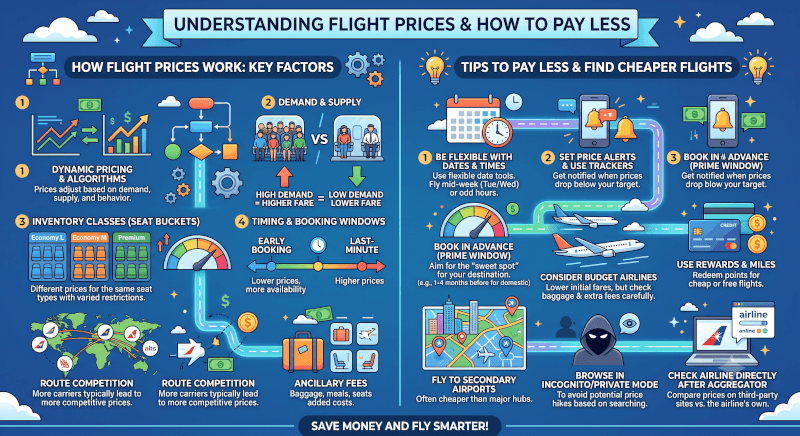

Airlines charge most for the flights people want: mid-morning departures, Friday evenings, Sunday returns. The discount lives at the other end of the timetable, on the departures that are harder to sell.
What counts as off-peak
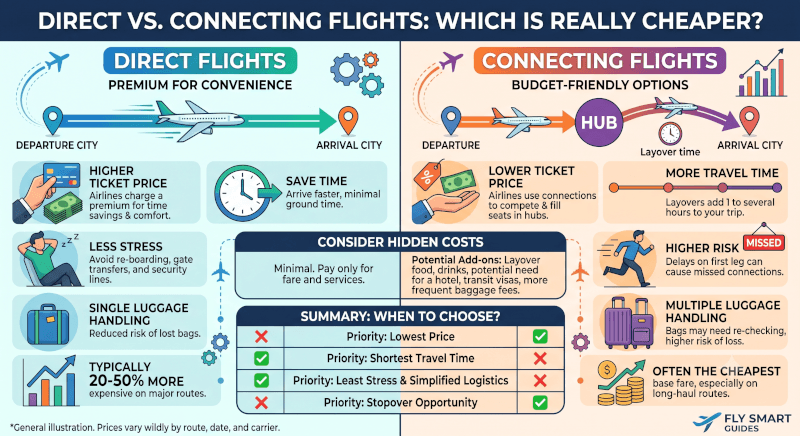
First flights of the day and last ones at night. Midweek departures, Tuesday and Wednesday classically. Overnight flights that land early in the morning. And the itineraries with an awkward connection that most people scroll past.
None of those are worse aircraft. They are the same seats with fewer buyers, so the cheap fare classes on them stay open longer.
The case for the overnight flight
It is often cheaper than the daytime equivalent, and it can replace a night of accommodation. Airports are quieter, security is faster, and landing in the morning gives you the whole day at the destination instead of arriving in time for dinner.
What you pay instead
Sleep, mostly. A red-eye works if you can actually rest on a plane, and costs you the first day if you cannot, which is a poor trade on a three-day trip and a fine one on a fortnight.
Then the ground: landing at five in the morning is no bargain if the train has not started and the hotel will not check you in for six hours. Price the taxi and the early check-in before you call it cheap.
And the discount is not guaranteed. On business-heavy routes the first flight out is the one executives want, so it can be the most expensive departure of the day. Worth checking rather than assuming.
Who it suits
Flexible travellers who would rather have the money than the comfort, and anyone who sleeps easily in transit. Less so if you are travelling with small children, or if something important happens shortly after you land.
The comparison is easy to make with real numbers instead of instinct: a route page shows the cheapest fare day by day, and an alert tells you when the off-peak departure has dropped far enough to be worth the inconvenience.