Check a fare on Monday, look again on Thursday, and it has moved. The swings are real. The calendar date you are booking on has very little to do with them.
One flight, dozens of prices
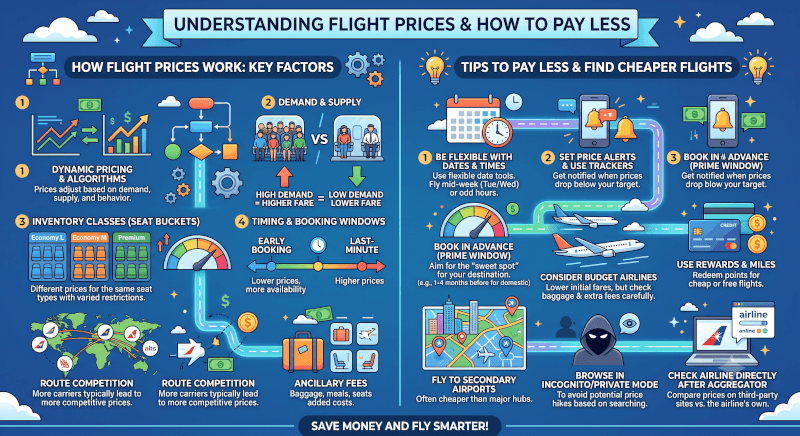
Airlines do not put a single price on a plane. Every cabin is split into fare classes, each with its own price and its own quota of seats. The cheapest classes hold the fewest seats. When those are gone, the booking system stops offering them and the next class up becomes the cheapest thing available. Nobody raised anything: a bucket emptied.
This is why two people in the same row can have paid wildly different amounts, and why a fare can move between two searches an hour apart. Revenue management software compares the pace of sales against the airline's forecast for that specific departure and reshuffles the quotas as it goes. A Tuesday flight selling faster than the model expected loses its cheap seats early. One selling slowly can get them back.
What follows from that
Demand is per departure, not per route. The Friday evening flight and the Tuesday lunchtime flight on the same city pair are separate markets with separate forecasts, which is why the gap between them is often larger than anything you can win by booking cleverly.
Competition works the same way. When a carrier opens a sale on a city pair, the others usually see it within hours and match, then the cheap classes on all of them drain together. That is the origin of the fare that looked impossible in the morning and is ordinary again by dinner.
Time to departure matters, but not as a smooth curve. Far out, prices wobble because almost nothing has sold and the forecast is a guess. In the last two or three weeks they tend to climb, because that is when business travellers book and airlines know it.
Why "book on a Tuesday" refuses to die
The advice comes from studies that averaged millions of bookings. On that scale a tiny effect survives the noise and gets a headline. Your trip is one route, one departure, one set of dates, and the effect is far too small to plan around. Sales are announced when a marketing team decides to announce them, and cheap classes open when a forecast is revised, neither of which consults the day of the week.
The pattern that does hold is less convenient: the low price is a moment, not a state. It exists while a cheap class is open, and it stops existing when the seats in it are sold.
What actually helps
Learn the normal range for your route before you shop. Without it, you cannot tell a sale from a banner, and a fare that is merely average will feel like a win.
Use whatever flexibility you have. Moving a departure by a day, flying mid-week, or accepting a less popular hour usually beats any booking trick, because you are moving to a different departure with a different forecast rather than trying to outwit the same one.
And accept that you cannot watch a route by hand. Checking twice a day means seeing two snapshots out of the dozens the algorithm produced. This is the part DiveFare takes over: you name the fare you would pay, we re-read your route every 15 minutes and write within a few minutes of a ticket reaching it, with a link to that fare.
None of this predicts the algorithm, and nothing can. It only means you are looking at the route during the minutes that matter instead of the minutes you happened to be free.