Every version of this question wants a date. Book 54 days out, book on a Tuesday, book eight weeks before a long haul. The honest answer is that there is a range where cheap fares are more likely, and inside that range the price still moves enough to make the range secondary.
Why a window exists at all
Too early and the airline has not yet opened its cheaper fare classes, because the forecast for that departure is still mostly assumption. Too late and those classes are gone, either sold or deliberately closed for the business travellers who book at the last minute and do not shop on price. The middle is where the cheap seats are both open and unsold.
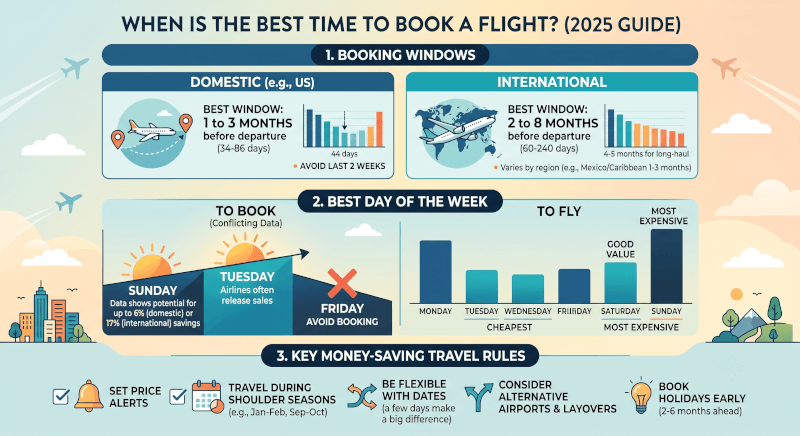
The ranges you see quoted, roughly one to three months ahead for short hops and two to six for long haul, come from averaging enormous numbers of bookings. They are a reasonable place to start thinking. They are averages of routes with nothing in common: a summer leisure route to the Mediterranean and a year-round business route to Frankfurt do not behave alike, and neither behaves like the average of the two.
Peak dates break the pattern
Around school holidays, Christmas, and big local events, the cheap classes sell out early and never reopen, because the airline knows the plane will fill anyway. For those dates, earlier genuinely is better, and waiting for a drop is waiting for something that has no reason to happen.
Booking day versus flying day
The day you fly matters. A midweek departure is usually cheaper than Friday evening or Sunday afternoon, and that is a different flight with a different forecast, not a trick. The day you book on matters far less, and organising your week around it is effort spent in the wrong place.
Working the window instead of guessing a date
Once your dates are roughly known, the practical move is to watch across the window rather than pick a moment inside it. If you book the day you decided to travel, you pay whatever the algorithm happens to be charging that minute; if you watch, you can take the dip when it happens.
That is what a price alert is for. Set a number as soon as you know the trip, then get on with something else. On any route we cover, the page also shows the cheapest option in each of the next three months, which is the fastest way to learn what "normal" looks like before you commit to a target.